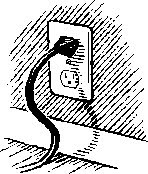
A smart grid is more than smart. It can be entertaining too. Utilities look at their wires in the most utilitarian way. You see, Broadband Over Powerlines is a real technology that can give utilities much more information about and control over the grid.
Think of the simplest things. What if the utility stopped burning gasoline, tires and shoe leather to read your meter each month. Wouldn't it be simpler to install a chip in your electric meter that is the same one on your cell phone? All it has to do is call the billing office once per month, report the kilowatt-hours you've used and send you a bill. That's smart. Or . . . just send the data back over the power lines to the billing office.
During blackouts it is sometimes difficult for utilities to pinpoint every home without power. What if the cell phone in the meter had a battery backup and called the utility office to report it was not getting power. Simple.
But there is more that a smart grid can do. It can provide continuous feedback to the utility about power usage throughout the day and night. Possibly avoiding widespread blackouts during peak times by doing rotating load shedding. It can provide you with time of day pricing. You want to run the dishwasher or washing machine after 10:00 p.m.? You can have a discount.
But there's more. Broadband over power lines can provide entertainment. Cable, telephone and internet services can be brought in over power lines. Imagine, every electric plug in your home can be a broadband data port and provide you with many services competitively.
It would be nice to have a little competition for your entertainment dollar, rather than the monopolies that control them now. Wouldn't it?
Monday, March 23, 2009


Tuesday, March 17, 2009
SUSTAINABILITY
We hear this word from time to time, so I thought we would examine it further. Apples, they're sustainable. Oranges too. Crops in general, barring some catastrophic event, are sustainable. It means we can perpetuate something, virtually forever.
However, with respect to energy,we are not currently in sustainable mode. The United States and the rest of the world have vast supplies of fossil fuels. They will last hundreds of years, maybe more. But they're not sustainable. We cannot perpetuate them beyond their finite limits, notwithstanding their abundance.
So, what is sustainable? Certainly, hydroelectric power is sustainable, assuming it continues to rain in some catchment basin forever. Wind power is sustainable, presuming the wind will blow forever. This too is a good assumption. Will the wind blow when you most need it is still up in the air. Solar power is certainly sustainable, at least for the five billion years of sunlight we have left. It presumes we have sufficient materials to continue to build solar collectors and photovoltaic cells. This is also a good assumption for the foreseeable future. But the sun shines on its own terms.
That's supply side sustainability. And at the moment with current technology the sustainability of these wonderful resources will not provide sufficient energy to displace fossil fuels long into the future . . . and maybe never. I'm not any happier than anyone else about that, but realism when it comes to sustainability is no vice. Paraphrased and stolen from, possibly, Cicero.
Unfortunately, we don't have enough demand side sustainability. Maybe I should say that the other way around. We have too much demand side sustainability. As a society, we constantly, almost mindlessly, sustain our demand for energy. Think of it in terms of two statistics: population growth and consumptive growth. Nothing is static.
There are seven billion people on planet earth. In one hundred years, who knows, that could increase by fifty percent. I didn't look up the estimates. Doesn't matter. All of those people will use energy. They're not going to sacrifice. In terms of growth in consumption, just look at yourself and others around you. Be honest. Desktop? Laptop? Blackberry? Cell phone? More than one? Digital camera? LCD or Plasma TV? Shall I go on?
Let's take something simple, like the digital camera. Are you willing to go back to using 35 millimeter film in a single lens reflex camera ? I date myself. The SLR didn't require a charge and only needed a battery for the flash. And a little flat battery for the light meter that lasted for years. Is such a thing even available any more, except on Ebay?
People are not willing to go backwards, no matter how many of us vocalize for sustainability. But there is an energy source that is sustainable and possibly forever, as best one can determine that period of time. I refer to the nuclear fast breeder reactor. This reactor actually creates more fuel than it uses. It can perpetuate the current known stock of uranium by 100 fold. And if we use the vast amounts of uranium that are in the sea, it is as close to sustainability as one can get with the population and consumption growth we experience.
Is this easy? No. Does it require resolve? Indeed. Is it a more plausible goal with the cooperation of the world's governments? Of course. Is there risk of proliferation? There is. But there are risks in everything we do. And when it comes to energy, it's all dirty in one form or another. No matter what technology we use, it creates something to clean up after. The question is do we run after tens of billions of annual tons of pollutants in the atmosphere? Or do we deal with a football field's worth of nuclear spent fuel and reprocessing risk over a long period of time? Let me know?
Saturday, March 7, 2009
The Invincible Ignorance of Government Officials
Ian Bowles, the secretary of energy and environmental affairs for the State of Massachusetts contributed an Op-Ed piece to the New York Times yesterday, March 6, 2009. After reading it, I had that sinking feeling in my stomach when I hear yet another government official get it wrong. Let’s tackle some major points one by one.
It’s admirable that President Obama would like to double renewable energy in three years. But it’s not likely. In three years, we’ll see. But let’s be realistic. There is just not enough renewable energy to double renewables (including hydroelectric power) from the current 7% of total energy consumed to 14% in that time period. Currently, coal contributes 22% of all energy consumed, mostly for electric power generation, and that represents 49% of all of the electricity generated in the United States. Are we really going to produce enough renewable energy in three years to essentially displace one third of the billion-plus tons of coal we burn each year? Natural gas represents 23%, petroleum 40% and nuclear power is 8% of all energy consumed. Biomass and hydroelectric power represent 89% of the 7% of renewables that we consume now. Government officials have to start reading their own government’s statistics produced by the Department of Energy (DOE) and the Energy Information Administration (EIA) before they spout this blather. In 2030 the EIA estimates that non-hydroelectric renewable energy will account for about 8% of all the energy consumed in the U.S.
There is a lot of hot air coming out of Washington and state capitals about renewables but let’s be factual. Ian Bowles wants offshore wind but it has been no easy task for developers to build a wind project off the coast of Massachusetts in Nantucket Sound. Opposition from Senator Kennedy and others have delayed this project. And the Long Island wind project was buried because Long Islanders just didn’t want to look at wind mills that were 400 feet tall and had a 400 foot wing span. Moreover, Mr. Bowles and others like him promote hydroelectric plants, but try getting one built in this country. There is no more big hydro coming because of objections ranging from fish spawning, recreational use of rivers, water usage fights, silting and huge water impoundments that submerge vast amounts of real estate along with the towns and people displaced by the deluge. There were protests in the states over the Three Gorges project in China. Everyone wants renewable energy until you start using vast amounts of their land near to where they live.
Mr. Bowles doesn’t like large transmission lines. He says that transmission losses “gobbles up an estimated 2 percent to 3 percent of electricity nationally.” First, let’s get this straight: Transmission and Distribution losses gobble up as much as 9% of the electricity generated at the power plant. That’s just a fact and it has not prevented us from building transmission in the past and it will not do so in the future. I commend to Mr. Bowles the EIA’s Annual Energy Review 2007, page 221, footnote “f”. It’s right there in the fine print. We need big transmission for important reasons. People do not want to live near power plants, so they are more often than not in more remote areas. We have to transmit that power to the load center. Moreover, more transmission lines will de-bottleneck the very inadequate electric transmission system in the country and reduce the need for additional generation. That means less fuel burned, less pollutants in the air and less carbon dioxide. I also commend to Mr. Bowles the "National Electric Transmission Congestion Study" produced by the DOE in August 2006.
The final point I’ll address is cap and trade. This is tantamount to a tax on all of us because the extent to which we burn fossil fuels, all of which contain carbon to one extent or another, will not be reduced for decades. And they will only be reduced in any significant way if we have a comprehensive (non-political) energy policy with real teeth. EIA’s statistics for all energy use that I quoted above show us that 85% (coal: 22%, natural gas: 23%, petroleum: 40%) of all energy used comes from carbon-producing fossil fuel. The cap and trade tax is a pretext. It will not reduce carbon any time soon but it will burden all of us, especially the least capable among us of paying it, with more taxes that our central government can waste. It's just taxes gussied up to look like something else.
With respect to an energy policy with teeth, if I were president . . . .
Saturday, February 21, 2009
Electric Car Charging in San Francisco
There is an article (http://www.physorg.com/news154288469.html) encouraging the use of electric charging stations in San Francisco as a way of cleaning up inner city air. My first thought is that I spend time in San Francisco occasionally and I find the city to be very clean, without any intrusion on my senses. Moreover, I work in New York City each day and I have spent my entire life in that city, having been born, raised and employed there and no where else. NYC is light years better in terms of air quality than it was when I was a boy.
But let's look at electric cars realistically. From the standpoint of efficiency, they're not better than the traditional internal combustion engine. Each car must be charged with electricity generated at a central station power plant. The average steam electric generating station in the U.S. is about 33% efficient. So two thirds of the energy used to generate a Kilowatt-hour is gone before it leaves the plant. In addition, losses on the transmission and distribution system (the wires that carry power) amount to up to 10% and the drive train of the vehicle, motors, electric power quality, etc. will likely reduce efficiency by a similar amount. Those additional reduction in efficiency, another 20%, reduces the electric car efficiency to around 26%. This is not much better than the internal combustion engine.
One can argue that we are reducing pollution. But are we? Or are we really displacing pollution. Every fossil-fuel burning power plant emits pollution of various kinds and amounts depending on the fuel used. What we do not endure from a tail pipe we still endure from a power plant stack. One can also argue that it's easier to control pollution from thousands of power plants rather than millions of cars and with that I agree. But is displacing the emissions from your vehicles to another community for the sake of your own air really fair?
Before the U.S. embarks on an all out electric car phase, the amount of infrastructure both in terms of power plants and millions, tens of millions, of charging stations should be examined very, very carefully. There has to be a benefit associated with the huge cost, not just the illusion of pollution reduction. Plus, if there's a black out, especially an extended one like the 2003 blackout of a large swath of the U.S., how will cars be charged? Is this potentially a national security issue?
There is a better way at this. One that is more efficient and ultimately pollution free. But that's for a future blog post.
But let's look at electric cars realistically. From the standpoint of efficiency, they're not better than the traditional internal combustion engine. Each car must be charged with electricity generated at a central station power plant. The average steam electric generating station in the U.S. is about 33% efficient. So two thirds of the energy used to generate a Kilowatt-hour is gone before it leaves the plant. In addition, losses on the transmission and distribution system (the wires that carry power) amount to up to 10% and the drive train of the vehicle, motors, electric power quality, etc. will likely reduce efficiency by a similar amount. Those additional reduction in efficiency, another 20%, reduces the electric car efficiency to around 26%. This is not much better than the internal combustion engine.
One can argue that we are reducing pollution. But are we? Or are we really displacing pollution. Every fossil-fuel burning power plant emits pollution of various kinds and amounts depending on the fuel used. What we do not endure from a tail pipe we still endure from a power plant stack. One can also argue that it's easier to control pollution from thousands of power plants rather than millions of cars and with that I agree. But is displacing the emissions from your vehicles to another community for the sake of your own air really fair?
Before the U.S. embarks on an all out electric car phase, the amount of infrastructure both in terms of power plants and millions, tens of millions, of charging stations should be examined very, very carefully. There has to be a benefit associated with the huge cost, not just the illusion of pollution reduction. Plus, if there's a black out, especially an extended one like the 2003 blackout of a large swath of the U.S., how will cars be charged? Is this potentially a national security issue?
There is a better way at this. One that is more efficient and ultimately pollution free. But that's for a future blog post.
Sunday, February 15, 2009
Sun + Fossil Fuel = Efficiency

I read an article (http://www.technologyreview.com/energy/22080/page1/) about how about using the heat of the sun can boost the efficiency of existing fossil fuel power plants. I thought this was an interesting concept to explore.
One type of power plants that is prevalent is called a combined cycle plant. It uses two different types of engines (cycles) to create electricity. One cycle is a combustion engine called a gas turbine or combustion turbine (Brayton Cycle) and the other is a steam engine or steam (Rankine) cycle. It is represented by the graphic (Source: Texas Utilities).
Let’s explain what’s going on here and how adding solar energy can improve the engine’s efficiency. Think of the Gas Turbine Cycle above as if it were an aircraft engine, which are also gas turbines. As you can see this engine drives an electric generator to create electricity. The exhaust gases from this engine are very hot, and if allowed to escape to the atmosphere, will dissipate and be of no use.
However, power plant designers have devised a way to capture and reuse this waste heat by running it through a boiler and powering a steam turbine cycle, represented at the bottom portion of the graphic above. Combined Cycle Power Plants are currently the most efficient way to create electricity.
So, how do we introduce the sun into this mix? In some combined cycle power plants, the boiler in the steam cycle is capable of being fired with additional fossil fuel, usually natural gas. This boosts the output of the plant during the peak times of the day when electricity use is at its highest. However, because it is firing additional fuel to obtain the increased output, it will usually be less efficient to do so. So why do it? The price of power is higher at the height of electric use or peak time of the day, so it is worthwhile to have reduced efficiency for additional plant output. Using heat provide by a solar collecting array eliminates the need for the additional fossil fuel.
Although sunlight may be free, the technology that turns sunlight it into steam is not. The power plant will have to build and pay for the solar array, but, as a result, over time the plant will produce more energy when it is most needed at a more predictable cost rather than the volatile and unknown expense of the displaced fossil fuel long into the future.
Sunday, February 8, 2009
BTUs and BLTs
Years ago, when I was a young engineer, the beginnings of energy deregulation were upon us. At the time, there were many meetings between my engineering colleagues and the financial community. It was our objective to help our clients raise financing for the projects we wanted to engineer and build. Back then, there were few in the financial community who knew much about energy. After one meeting, I turned to one of my colleagues and said, "He wouldn't know a Btu from a BLT."
Of course, the financial community today, thirty years later, is expert in all forms of energy and adept at financing projects of all kinds. However, the phrase that I coined so long ago has followed me, in a good way, all of this time. And according to the person I said it to, who has provided engineering consulting services around the globe and related it to his clients, says he has heard it translated into many languages, humorously.
I use it here because it is part of the light-hearted title of a book I'm writing about energy. As someone who has been associated with energy all of my career, I find that there is a lot of information and misinformation in the discourse about energy. My upcoming book and this blog, with constructive feedback and dialogue from those who visit here, will try to illuminate this subject so that we can all become more learned when it come to this most important resource and its impact on our economy and our lives.
Of course, the financial community today, thirty years later, is expert in all forms of energy and adept at financing projects of all kinds. However, the phrase that I coined so long ago has followed me, in a good way, all of this time. And according to the person I said it to, who has provided engineering consulting services around the globe and related it to his clients, says he has heard it translated into many languages, humorously.
I use it here because it is part of the light-hearted title of a book I'm writing about energy. As someone who has been associated with energy all of my career, I find that there is a lot of information and misinformation in the discourse about energy. My upcoming book and this blog, with constructive feedback and dialogue from those who visit here, will try to illuminate this subject so that we can all become more learned when it come to this most important resource and its impact on our economy and our lives.
Subscribe to:
Posts (Atom)

 Posts
Posts

